Space shooter - Galaxy attack
- 4.8
- Rating
- 100.00M
- Installs
- Free
- Price
 Analysis by App-foxy
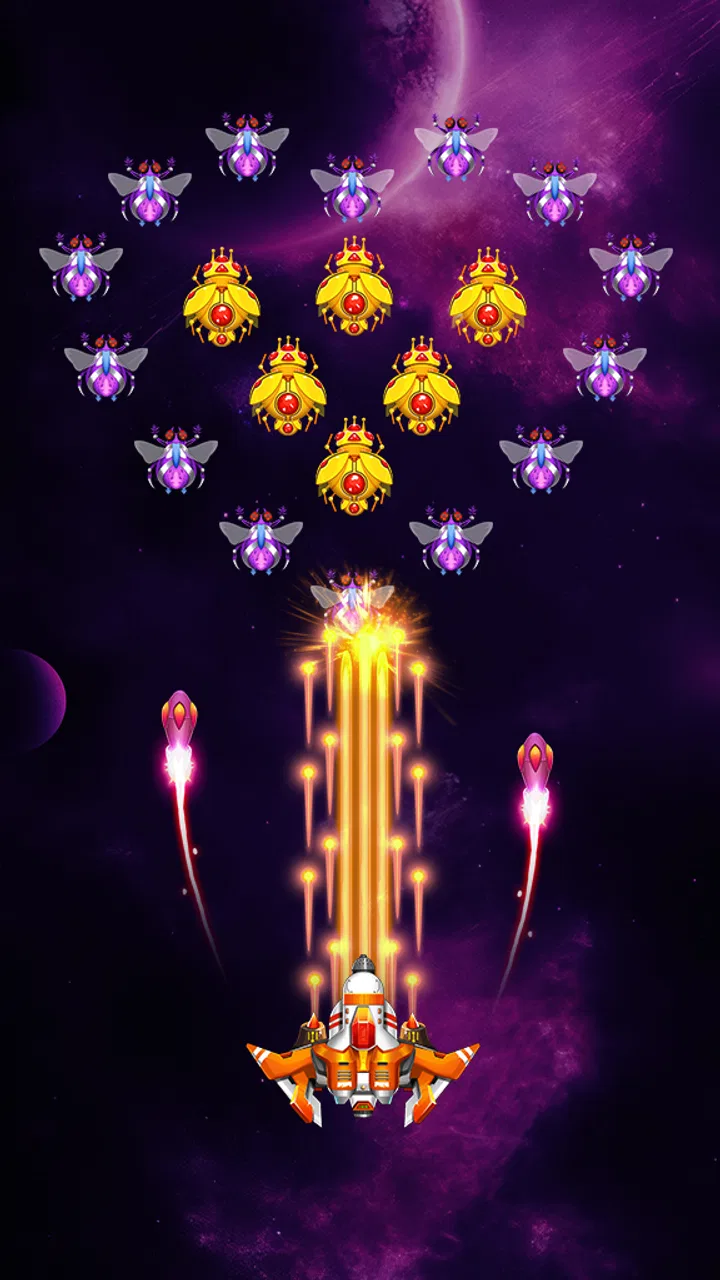
Space shooter - Galaxy attack is the kind of arcade game I open when I want a quick burst of action rather than a long story or complicated strategy system. I control a small spacecraft, move across the screen, avoid incoming fire, and keep attacking waves of enemies while the pace gradually demands more attention. The basic idea is familiar, but the appeal comes from how quickly a short session can become a test of timing, positioning, and concentration.
After spending time with it, I see why it has become such a widely played mobile shooter. It is free to start, easy to understand, and built around the satisfying loop of surviving one more attack, improving a run, and trying again after a mistake. The game comes from 1SOFT and sits firmly in the arcade category. Its average rating is 4.8 from around 1.9 million ratings, while its install count has passed 100 million. Those figures do not replace personal experience, but they do reflect how accessible this style of play is.
I would recommend it to someone who enjoys classic space shooters but wants controls that suit a phone. I would be more cautious with it for anyone looking for a deep campaign, a relaxed pace, or a completely distraction-free experience. Its strengths are immediate action and repeatable play; its weaknesses are the familiar pressure of progression systems and the possibility that repetition will eventually outweigh the excitement.
You May Also Like

 Blood Strike: 2.5 Anniversary
Blood Strike’s Loadouts Turn Every Drop Into a Tactical Gamble
A close look at Blood Strike’s custom loadouts: how fast access to signature weapons reshapes its battle royale rhythm, rewards preparation, and narrows the gap between fights.

 Pandora - Music & Podcasts
Pandora’s Music Is Easy to Start, but Harder to Recover
Pandora’s strength is its low-effort path from a seed to a station. Its weak spot is how much confidence it asks you to place in connection, setup, and quiet recovery.

 8 Ball Pool
 Is Built on Rivalries, Rematches, and Routine
A close look at the rivalries, rematches, shared routines, and unanswered safety questions that turn a quick pool match into a persistent mobile community.

 Samsung Music
’s Quiet Strength Is Playing What You Already Own
Its reach comes less from spectacle than from dependable access to a personal library. That simplicity is both the app’s strongest retention engine and its ceiling.

 AccuWeather: Weather Radar
AccuWeather Review: A Quick, Clear Forecast for Everyday Decisions
For everyday plans, the best forecast is the one you can understand quickly. AccuWeather makes rain timing, radar, and local conditions easy to act on, with a few trade-offs.

 Hill Climb Racing
Why Hill Climb Racing Still Turns Crashes Into One More Run
A tiny car, a bumpy hill and one more upgrade: Hill Climb Racing keeps resurfacing because its simple chaos makes every near-miss feel personal.
More From Our News Desk



How a normal session feels from the first launch
The baseline workflow is simple. I start a stage, keep the ship moving, watch the enemy formations, and fire while trying not to drift into projectiles. That simplicity is useful because I do not need to remember a complicated control scheme before playing. A few seconds are enough to understand the central rhythm: movement is defensive, shooting is constant, and survival depends on reading what is about to happen rather than reacting only after the danger arrives.
The touchscreen controls work best when I treat my finger as a guide for the ship instead of trying to tap repeatedly around the display. Small movements are usually more useful than dramatic swipes. When I drag too far, I often create a new problem by moving into another lane of fire. Keeping the ship near a manageable area of the screen gives me more time to respond, especially when enemies approach from several directions.
One practical routine is to spend the opening part of a stage learning its rhythm instead of immediately chasing every target. I watch where the first projectiles travel, notice whether the enemy group advances in a straight pattern or breaks formation, and then choose a safe position. This is a better habit than constantly crossing the screen. The game rewards awareness, and frantic movement can make a survivable situation harder.
A realistic everyday use case is a short break between tasks. I can play one attempt while waiting for a meeting, riding as a passenger, or taking a few minutes away from work. The game does not require me to understand a large fictional universe before I can enjoy it. At the same time, it is not always ideal for a very brief moment when I need to stop instantly, because a tense section can make it tempting to continue rather than put the phone down.
The classic arcade influence is obvious, but this is not exactly the same as playing an old cabinet. On a phone, the display is smaller, the finger can cover part of the action, and the feeling of control depends heavily on how smoothly I move. That makes screen position important. I try not to place my finger directly over the ship for long periods, because losing sight of the spacecraft makes narrow dodges less reliable.
The game is rated for Everyone, which matches its straightforward presentation and easy-to-learn premise. Still, “easy to start” does not mean every stage is effortless. The early experience teaches the basic loop, while later attempts ask for more disciplined movement. Younger players may understand the controls quickly, but adults should still remember that the free-to-play structure and in-app purchases can affect how the overall experience feels.
Settings I would check before settling into a routine
I do not recommend changing everything immediately. I first play enough to understand the default control response, then adjust only what makes movement more comfortable. The most important setting for me is the control behavior: I want the ship to follow my finger predictably, without needing exaggerated gestures. If the default movement feels too sensitive, slower and smaller drags are safer than trying to compensate with constant corrections.
Sound is another practical choice. Audio can make enemy arrivals and attacks feel more noticeable, but it is not always convenient in public or at night. I often lower it when playing during a short break and keep the visual action as my main source of information. If you prefer playing without sound, it is worth paying closer attention to the edges of the screen, because visual awareness becomes more important when there are no audio cues to add atmosphere.
I also treat notification and purchase decisions as part of the setup, not as something to ignore until later. The game is free, but individual in-app purchases range from $0.99 to $104.99. That wide range is a reason to decide in advance whether I want to spend anything at all. For a child’s device, I would use the phone’s normal purchase controls and agree on a clear rule before handing it over. The game can be enjoyed without turning every difficult moment into a buying decision.
One useful setting habit is to test the game in the same way I expect to play it. If I usually hold the phone with one hand, I check whether my thumb can move the ship without blocking too much of the action. If I use two hands, I leave enough space for the movement finger to travel smoothly. This sounds minor, but comfort affects accuracy more than many players expect. A control layout that feels fine for thirty seconds can become tiring during a longer session.
The developer, 1SOFT, released the game on Apr 5, 2017, and it supports Android 7.0 or later. That makes compatibility straightforward for many Android devices, although the quality of play still depends on the phone’s screen, touch response, and general condition. I would not judge the game only by whether it installs. A device with a cramped display or unreliable touch input can make precise movement frustrating even when the operating system is supported.
Faster patterns that make repeated runs less chaotic
Experienced play is less about moving quickly and more about moving deliberately. My first improvement came from stopping the habit of sweeping from one side to the other whenever an enemy appeared. Instead, I try to keep a central or slightly offset position and move only far enough to create a clear path. This preserves options. If I rush toward one opening, I may discover that the next attack closes it.
I also separate aiming from survival in my attention. The ship’s attack is useful, but staying alive gives me more opportunities to deal damage. When a formation looks tempting, I do not automatically chase the most exposed target. I ask whether reaching it would put the ship underneath a dangerous line of fire. Sometimes the best choice is to remain in a safe lane and let the attack continue while I wait for a better opening.
A repeatable habit is to identify the safest side of the screen before the action becomes crowded. I do not stay there permanently, because predictable movement can become dangerous, but having a fallback direction reduces panic. If the center suddenly fills with projectiles, I already know where I want to move. This is more reliable than searching for safety after the screen has become busy.
Short, controlled corrections are especially valuable near the edges. I try to avoid hugging a boundary unless the pattern clearly requires it, because an edge limits the number of escape routes. When I am near a side, I leave enough room to reverse direction. That small reserve of space is one of the easiest ways to reduce mistakes during a hectic sequence.
Another useful workflow is to review the reason for a failed attempt instead of simply restarting. Was I watching the enemy, the projectile, or the ship? Did I move because I had a plan, or because I panicked? Was I trying to collect a possible reward at an unsafe moment? These questions turn repetition into practice. Without that reflection, repeated runs can become the same mistake performed with more frustration.
The game is also a good fit for players who enjoy improving through small adjustments. I might spend one session focusing only on movement discipline, then another on recognizing attack patterns. This keeps the arcade loop from feeling completely random. The goal is not to make every run perfect; it is to make each failure teach me something specific about spacing and timing.
Where the progression helps, and where it can become friction
The main limitation is that the basic formula can feel repetitive if I need constant novelty. Space shooter - Galaxy attack gives me an immediate arcade challenge, but it is not the right choice when I want a narrative adventure or a game built around exploration and character development. A story-driven space game would be a better alternative for someone who wants dialogue, world-building, and a sense of traveling through a larger universe.
It is also less suitable for players who dislike free-to-play pressure. Even when I intend to spend nothing, progression can make me aware of upgrades and purchase options. That does not automatically ruin the game, but it changes the mood. The pure arcade experience is strongest when I focus on improving my decisions rather than treating every obstacle as a reason to accelerate progress with money.
The purchase range matters because it can create a very different experience for different players. Someone who never buys anything may approach each attempt patiently and accept slower progress. Someone comfortable spending may reduce some of that waiting or difficulty. Neither approach is inherently wrong, but I prefer deciding my boundary before I become attached to a particular upgrade or run.
There is another trade-off in the control design. Touch movement is convenient and immediately understandable, yet it cannot always match the precision of a physical arcade stick or controller. If you are looking for exact, competition-level input, a dedicated controller-friendly game may suit you better. For casual and intermediate play, the touchscreen is adequate, but the difference becomes noticeable when several threats overlap and a tiny movement matters.
The game’s Everyone rating makes it broadly approachable, but parents should still distinguish content suitability from spending suitability. The visual premise is uncomplicated, while the purchase structure deserves a separate conversation. I would let a younger player try it under a clear device rule, especially if the phone is linked to a payment method.
Who gets the most from this arcade shooter
I think it is strongest for people who enjoy repeatable challenges. If you like restarting after a mistake, learning a pattern, and gradually becoming calmer under pressure, the game has a satisfying loop. It also works well for players who want a space-themed game without a long tutorial. The controls communicate the idea quickly, and the first few sessions can be enjoyable even if you have little experience with shooters.
It is a good choice for a commute or short break when you want active entertainment rather than passive scrolling. I would keep sessions intentional, though. Because each attempt encourages one more try, the game can quietly expand a five-minute break into a much longer one. Setting a stopping point before starting is useful when I have another task waiting.
I would skip it if your priority is a calm game with no pressure, a rich story, or a completely premium experience. I would also look elsewhere if you become annoyed by repeating similar action or if touch controls make you uncomfortable. A slower puzzle game, a narrative title, or a paid arcade game without purchase prompts may be a better fit depending on what you want from your phone.
For players comparing it with other mobile space shooters, its advantage is the low barrier to entry and familiar arcade structure. More complex alternatives may offer deeper ship customization, longer missions, or more elaborate presentation, but they also demand more time and attention. This one is easier to pick up, though that convenience comes with less depth in the moment-to-moment concept.
My approach to getting better without overcomplicating it
I would begin by playing several attempts with one goal: survive through movement rather than trying to maximize every possible opportunity. Once that feels comfortable, I would add a second goal, such as keeping a fallback route open or avoiding unnecessary trips across the screen. This staged approach is more effective than trying to improve aim, speed, positioning, and progression all at once.
I also recommend playing with a clean screen and a comfortable grip. Finger placement is not a cosmetic detail in a game where the ship may need to move through narrow spaces. I keep my movement finger low enough to see the action and avoid covering the area where the next threat is likely to appear. If the phone is warm, the screen is dirty, or my grip is unstable, I expect less precision and avoid blaming every mistake on the game.
When I fail, I look for the earliest avoidable decision. The final collision is often only the result of a mistake made several seconds earlier, such as moving too far toward a target or giving up a safe central position. Correcting that earlier choice makes future attempts feel more controlled. This is one of the game’s better qualities: even a simple arcade loop can reward careful self-review.
The most useful advanced habit is preserving an escape route before you need it. That means avoiding unnecessary edge movement, resisting panic swipes, and treating open space as a resource. I do not need a secret technique or a complicated setup to apply it. I simply try to make each movement leave the ship with at least one sensible next move.
Final verdict for everyday players
Space shooter - Galaxy attack succeeds because it understands the appeal of a classic arcade shooter on a phone. It starts quickly, communicates its objective clearly, and gives me a reason to replay a stage after a mistake. The work of mastering it is not hidden behind an elaborate system; it comes from learning when to move, when to hold position, and when not to chase a tempting target.
Its free price makes trying it easy, while the in-app purchase range means I would approach spending carefully. The game is suitable for Everyone, supports Android 7.0 and later, and has been available since Apr 5, 2017. With around 39,000 reviews and more than 100 million installs, it is clearly an established mobile title rather than an obscure experiment, but popularity does not change the fact that its repetitive arcade design will not suit everyone.
My recommendation is straightforward: try it if you want accessible space action, short repeatable sessions, and a game where better movement matters more than memorizing a complicated interface. Skip it if you want a substantial story, a peaceful experience, or no free-to-play friction. For me, it works best when I play with a simple routine, keep purchases separate from skill improvement, and treat every run as practice rather than a demand to win immediately.
FAQs for Space shooter - Galaxy attack
01What is Space Shooter - Galaxy Attack about?
Space Shooter - Galaxy Attack is an exhilarating arcade-style game where players pilot a spaceship to defend the galaxy from waves of alien invaders. The game involves strategic shooting, dodging enemy attacks, and collecting power-ups to enhance your ship's capabilities. With increasingly challenging levels, it's a thrilling test of reflexes and strategy.
02Is Space Shooter - Galaxy Attack free to play?
Yes, Space Shooter - Galaxy Attack is free to download and play on both Android and iOS devices. However, it does offer in-app purchases for those who wish to enhance their gaming experience further. These purchases can include new ships, weapons, and power-ups to help you advance through the game more efficiently.
03What are the system requirements for Space Shooter - Galaxy Attack?
Space Shooter - Galaxy Attack requires at least Android 4.1 or iOS 9.0 to run smoothly. It's compatible with most smartphones and tablets, ensuring that players can enjoy the game on a wide range of devices. However, a device with a decent processor and adequate RAM will provide the best experience, especially during more intense gameplay.
04Can I play Space Shooter - Galaxy Attack offline?
Yes, Space Shooter - Galaxy Attack can be played offline, allowing you to enjoy the game without an internet connection. This is particularly useful for playing during travel or in areas with limited connectivity. However, certain features like leaderboards and in-app purchases may require an internet connection to access.
05How does multiplayer work in Space Shooter - Galaxy Attack?
Space Shooter - Galaxy Attack offers a multiplayer mode where you can compete against other players in real-time. This feature requires an internet connection and allows you to battle friends or global players. Climb the ranks in competitive matches and showcase your skills on leaderboards to become the ultimate space defender.
Pros
- Engaging gameplay with dynamic challenges.
- Variety of spaceships for personalized play.
- Stunning graphics and vibrant visuals.
- Responsive controls enhance user experience.
- Regular updates with new content.
Cons
- In-app purchases can be quite expensive.
- Occasional ads disrupt gameplay flow.
- Requires constant internet connection.
- Difficulty spikes can frustrate new players.
- Limited offline mode options.

Space shooter - Galaxy attack
Gallery